The 4 Most Common Blockers Non-Technical Founders Face in Product Development and How to Avoid
There are four common blockers that non technical founders encounter. Here are the solutions to help early teams overcome them effectively.

As a founder and investor, I have worked closely with a lot of non-technical founders. The same four blockers come up again and again, and none of them are technical. They are all decisions made before anyone writes code.
The four most common blockers, and what to do about each
Blocker 1: No strategy
You are fired up and ready to start building. But have you laid out a strategy? Without one you burn months and budget moving in a direction nobody validated.
Solution
Define your vision, goals, and target market first. Understand your customers’ pain points and how your product solves them. Build a roadmap with real milestones and deliverables. This is the thinking most firms skip, and skipping it is what turns a product bet into an expensive guess.
Blocker 2: No product validation
Building before validating is jumping into a deep pool without knowing whether you can swim. Before you commit to a build, you need evidence that the product is wanted, buildable, and able to make money.
Solution
Validate in three areas, in this order:
-
Market validation. Does the problem exist at a scale worth solving, and will the people who have it pay to make it go away? Talk to buyers, not friends. Look for evidence of what they already spend money on.
-
Technical validation. Can this be built with the constraints you actually have: budget, timeline, regulatory exposure, integrations with systems you do not control? The riskiest technical assumption should be tested first, not last.
-
Commercial validation. Does the unit economics work once you factor in what it costs to build and run? A product that works and nobody can profitably sell is still a failed product.
Get validation in all three and you are no longer guessing about whether to build. You are deciding how.
Blocker 3: No product manager
A ship without a captain. Not having a product manager means nobody is bridging your vision and the technical execution: keeping the team aligned, protecting priorities, and making the tradeoff calls when reality pushes back.
Solution
Put a skilled product manager on the team, or work with a partner who brings one. The role is not administrative. It is the person who says no to the wrong work, sequences the right work, and keeps decisions moving so the team never stalls waiting on you. Decision latency is the single biggest source of delivery unpredictability I have seen in twenty years, and a good product manager is how you remove it.
Blocker 4: Hiring in-house too early
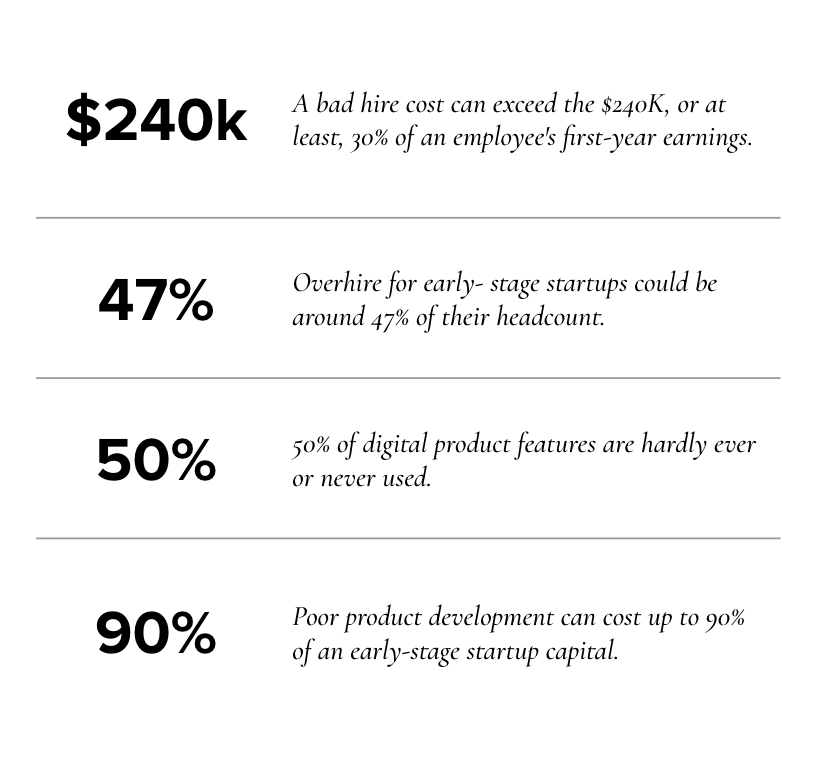
The urge to hire a full in-house team from day one is natural. Having control over every part of the build is enticing. But hiring in-house too early drains cash, adds fixed overhead before you have proven the product, and locks you into a team shape you chose before you understood the problem.
Solution
Bring in a partner who has built this before, and hire in-house once you know what you are hiring for. What you want from that partner is not extra hands. It is judgment: someone who will challenge the idea, flag the risks, and tell you when something should not be built. The right partner also carries the delivery risk rather than billing you by the hour while you carry it. See why we don’t estimate for what that looks like in practice.
Avoid these four and product development stops being a bet you place and starts being a plan you execute. Define the strategy, validate before you build, put someone in charge of the product, and buy judgment before you buy headcount. If you want to understand why so many builds still miss their dates even when the team is good, read The Predictability Gap. If you want to talk through your own product bet, book a call.