Vibe Coding vs. Agentic Engineering: Which One You Should Actually Use
Both vibe coding and agentic engineering use AI to build software. The difference isn't quality — it's accountability. Here's how to choose.
There are now two distinct modes of AI-assisted development. Most teams are using both — often without realizing they’ve switched between them, and rarely thinking about which one the situation actually calls for.
Understanding the difference isn’t an academic exercise. Using the wrong mode on the wrong kind of work is one of the most reliable ways to end up with software that doesn’t ship on time, doesn’t behave as intended, or creates liability in regulated environments.
What is vibe coding?
Vibe coding is what it sounds like. You describe what you want — roughly, conversationally, iteratively — and AI writes the code. You react to what comes out, adjust, regenerate. The feedback loop is tight. The pace is fast. You don’t necessarily understand every line the model produces, and that’s fine, because you’re exploring.
It’s the mode that’s made “I built this in a weekend” stories mainstream. Solo founders, researchers, internal tool builders — anyone who needs to get something working fast and isn’t accountable to anyone else for how it behaves. Karpathy coined the term and was explicit about what it optimizes for: flow state, speed, exploration. Not production reliability. Not audit trails. Not the ability to explain to a carrier review committee what happened and why.
Vibe coding is genuinely powerful for what it’s designed for. The problem is that it’s increasingly being applied to problems it wasn’t designed for.
What is agentic engineering?
Agentic engineering is a structured approach to AI-assisted development where human approval gates are built into the process as infrastructure, not discipline. AI proposes. Humans review. Humans approve. AI executes against the approved plan. The output — every decision, every approval, every implementation step — is logged.
The key distinction from vibe coding isn’t the sophistication of the AI or the quality of the code. It’s that the process is legible and accountable. You can trace any output back to an approved decision. You can show a regulator, a client, or a carrier exactly what was decided, who approved it, and when.
This is the mode that makes delivery commitments real. When you tell a client “this ships on June 15 at this price,” there’s a process producing that outcome, not just a hope.
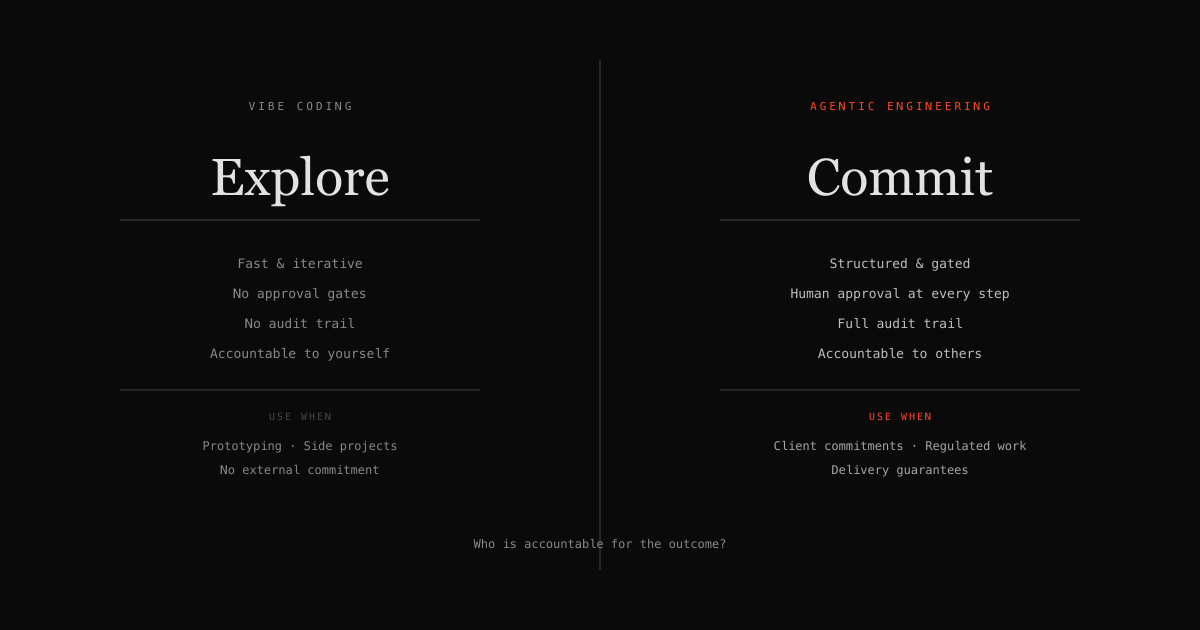
What is the real difference between vibe coding and agentic engineering?
Not quality. Not speed, at the team level. The real difference is who’s accountable for the outcome.
Vibe coding is the right tool when the accountability is to yourself. You’re exploring, prototyping, building something throwaway, or doing greenfield work where the only person affected by a failure is you. The absence of gates and audit trails isn’t a bug — it’s a feature. Gates slow you down. When nobody else is depending on what you’re building, that tradeoff makes sense.
Agentic engineering is the right tool when the accountability is to someone else. A client who paid for a specific outcome. A carrier that requires compliance evidence. A regulator who may ask for documentation. An investor who funded a system that’s now in production. The moment someone other than you is relying on the output — on its correctness, its reliability, its compliance, or its timeline — the absence of accountability structure becomes a liability.
The simplest test: if something goes wrong, can you explain what happened and why? Vibe coding has no answer. Agentic engineering has a record.
When should you vibe code?
Use vibe coding when:
- You’re building a prototype or proof of concept with no production intent
- You’re the only person accountable for the outcome
- You’re in genuine exploration mode — testing whether something is possible, not committing that it will ship
- The cost of failure is low and borne entirely by you
- You need to move as fast as possible and the normal constraints don’t apply
Vibe coding is what you do during a hackathon, a side project, an internal experiment. It’s how you figure out whether something is worth building seriously. It is not how you build the thing that you then commit to a client, certify to a regulator, or stake a carrier relationship on.
When does agentic engineering become necessary?
When:
- You’ve made a delivery commitment to someone else — a client, a partner, an investor
- You’re operating in a regulated environment where the outputs need to be traceable and defensible
- You’re coordinating a team where multiple people’s work needs to integrate predictably
- The cost of a wrong output isn’t a learning — it’s a liability
- You need to forecast when things will ship, not just whether they might
In regulated industries — insurance, healthcare, financial services — agentic engineering isn’t a best practice. It’s the minimum viable process. When your system processes a claim, binds an insurance policy, or advises on a financial product, there’s a legal and regulatory expectation that the system behaved as intended and that you can prove it. “The AI produced it” is not an answer. The approval record is.
Why does the choice matter more in regulated industries?
Because the audit trail isn’t optional. Every output your system produces that affects a coverage decision, a clinical workflow, or a financial transaction creates a documentation obligation. That obligation doesn’t disappear because the software was AI-generated.
What changes in regulated environments isn’t the question of whether to document — it’s whether the documentation is an afterthought or a byproduct of the process. In agentic engineering, it’s a byproduct. The same process that produces working code produces the record. In vibe coding, documentation is something you go back and create after the fact, if you create it at all.
This is part of why compliance-heavy industries are actually better candidates for agentic engineering than for the “move fast” approach that’s fine in consumer software. The constraints that feel like friction in vibe coding — approval gates, logged decisions, validated acceptance criteria — are exactly what regulated environments require anyway. The structure isn’t overhead. It’s the output.
What happens when teams apply the wrong mode?
The most common failure pattern: a team adopts AI tooling enthusiastically, productivity goes up, and then delivery predictability collapses. Engineers are shipping more code. Teams are shipping the same or fewer commitments. And when something goes wrong — a compliance failure, a missed deadline, an integration that doesn’t behave as expected — there’s no record of what was decided, who approved it, or what the system was supposed to do.
This is the predictability gap in its AI-accelerated form. The gap between what teams can produce and what they can commit to has always existed. AI makes individual engineers faster. Without the right process, it doesn’t make teams more predictable — it makes them faster at generating uncertainty.
The fix isn’t less AI. It’s the right process for the right mode. Vibe coding where exploration is warranted. Agentic engineering where commitment is required.
The choice is a delivery decision, not a tooling decision
Every team that uses AI has implicitly chosen a mode. Most haven’t chosen it consciously. They’ve drifted toward whatever felt faster in the moment, which usually means vibe coding, even in contexts where agentic engineering is what the situation actually requires.
The question worth asking isn’t “what AI tools should we use?” It’s “what are we accountable for, and does our process match that accountability?”
If you’re building for yourself: vibe code freely.
If you’re building for someone else, in a regulated context, against a committed timeline: the process needs to produce a record. Not because it’s bureaucratic best practice, but because the commitment you made requires it.
That’s not a constraint on AI-assisted development. It’s what makes AI-assisted development trustworthy enough to bet a delivery guarantee on.